








Summary
Neon is perfect for platforms that need to offer every user their own Postgres database. You provision via API, integrate the database into your product, and your users never have to create a Neon account unless you want them to.
- Instant - Databases provision in about a second and resume from scale-to-zero in around 500ms
- Isolated - Every user gets a dedicated Neon project with its own connection string
- Practically free at idle - Inactive databases suspend automatically, so you pay for what is used, not for what sits waiting
- API-first - Provision, set quotas, track usage, and transfer ownership programmatically across tens or hundreds of thousands of projects
- Claimable when you need it - Spin up a database with no signup, then let the user claim it into their own Neon account later
This page covers the embedded Postgres model for SaaS and developer platforms. If you are building an agent product that provisions Neon for end users, see also Neon for AI Agent Platforms.
Built to scale Postgres fleets
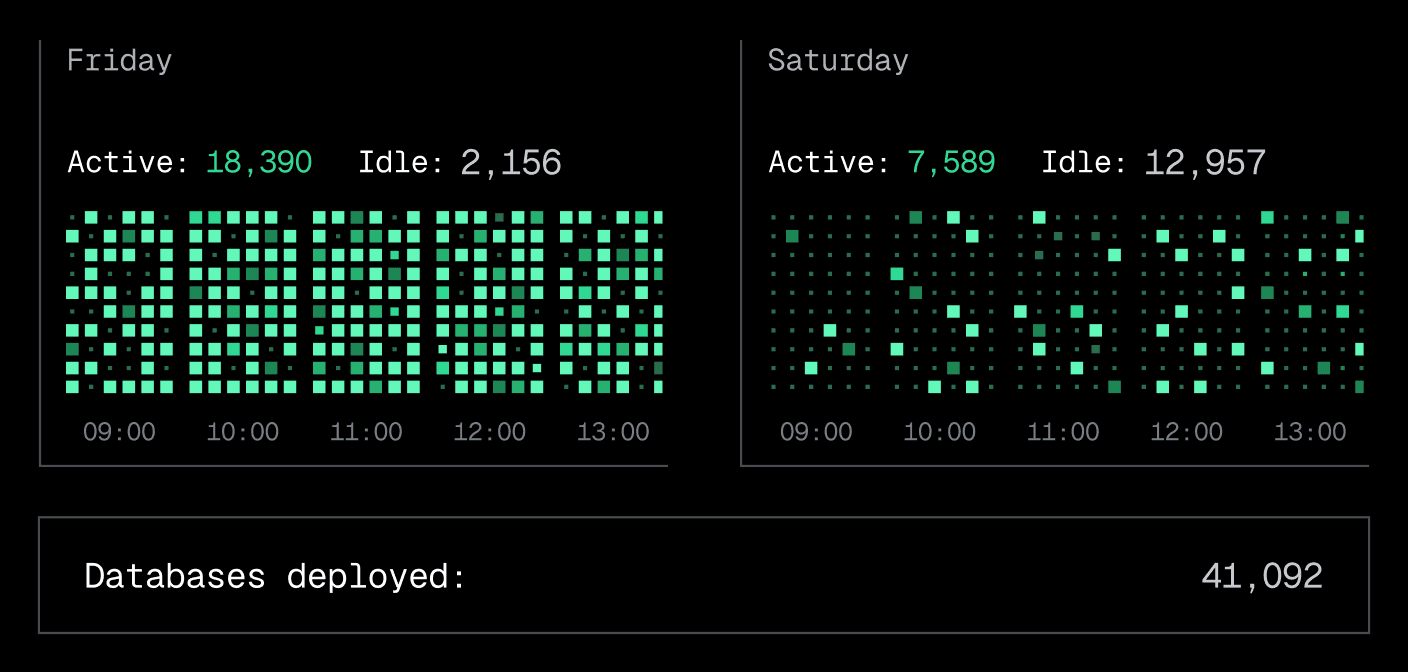
Neon is the Postgres layer platforms use when every user, workspace, or generated app needs its own database. You do not need a DevOps team to run a large Neon fleet. The Neon API lets you track usage, enforce limits, and scale programmatically. With pay-per-use pricing and automatic scale-to-zero, you spend a fraction of what you'd pay on AWS for the same fleet.
What you get:
- Dedicated connection strings for every user or project, each in its own secure, isolated Neon project
- High connection capacity, with pooled endpoints that support up to 10,000 connections
- Full Postgres compatibility, with no proprietary query layer
- Branching and instant restore for copies and rollbacks, without manual backups
- Multi-region placement, autoscaling, and high availability on the same model
"We’ve been able to manage 300K+ Postgres databases via the Neon API. It saved us a tremendous amount of time and engineering effort."

Instant provisioning and scale-to-zero
Neon databases provision in less than a second and automatically suspend when idle, with no compute cost until the next query. That is what makes dedicated Postgres per user viable: isolation without the cost of idle infrastructure.
- Provisioning time: ~1 second
- Suspend latency: configurable (default is 5 minutes)
- Resume latency (cold start): ~500ms
Read about the benefits of database-per-user architectures
API-first fleet management
Neon's API is built for platforms that manage large fleets of Postgres databases with minimal engineering effort. It has been shaped in collaboration with partners running at the edge of scale and automation. Via the Neon API, you can:
- Provision new databases instantly
- Set per-project resource limits to support free, pro, and enterprise plans
- Scale compute up or down per user or tier
- Automatically suspend inactive databases to reduce costs
- Monitor usage across thousands of projects
- Update quotas and configurations without downtime
Retool uses the Neon API to manage over 300,000 databases with just one engineer, handling everything from provisioning to quota enforcement.
Built-in quotas and billing controls
Define usage limits per project to manage cost and enforce pricing tiers. As users upgrade or change plans, you can update limits via API without downtime or user impact.
- Set maximum allowed storage
- Cap CPU usage
- Limit egress by plan
- Track and cap monthly data written
- Customize suspend timeouts for different tiers
Koyeb’s Database Instance Types show how to use Neon’s quota controls to define compute, storage, write, and data transfer limits per plan.
Tracking usage at scale
Neon also provides consumption APIs for observability across the fleet:
| Endpoint | Description | Availability |
|---|---|---|
| Account-level cumulative metrics | Aggregate metrics across all projects in the account | Scale and Business plans |
| Granular project-level metrics | Usage metrics per project at hourly, daily, or monthly granularity | Scale and Business plans |
| Single project metrics | Detailed metrics and quota info for an individual project | All plans |
You can use these to:
- Monitor total usage across all projects for a billing period
- Break down metrics by project or time range (hourly, daily, monthly)
- Power usage-based billing or internal dashboards
Learn how to query consumption metrics via the API
"Neon’s serverless philosophy is aligned with our vision: no infrastructure to manage, no servers to provision, no database cluster to maintain."
Claimable databases for frictionless onboarding
Not every platform wants users to create a Neon account before they get a database. The claimable database flow is the flavor of this use case for plugins, CLIs, and platforms that want instant Postgres with deferred ownership.
You create the database on behalf of the user. They get a connection string immediately, with no signup. If they do not claim it, the database expires after 72 hours. When they are ready, they claim ownership into their own Neon account, and the connection string stays valid.
That pattern fits:
- Framework plugins and CLI tools
- Demo environments and trial experiences
- Educational platforms handing out databases to students
- Development tools that need instant database access
- SaaS products that want deferred account creation
Example: Netlify DB
Via Netlify DB developers and agents can provision a production-ready Postgres database from a Netlify project in one click or one CLI command, with no external signup. If they wish, they claim the database into a Neon account.
Netlify DB provisioning a Postgres database from a Netlify project, powered by Neon's claimable database flow. Read the launch post.
Implement claimable databases
- Platform integration overview: claimable database flow - when this path fits vs embedded Postgres, OAuth, or the Agent plan
- Claimable database integration guide - create a project, issue a transfer request, and hand off ownership
- Claimable Postgres - reference for the neon.new instant-database flow
"Our users were asking for preview environments that already had their data in place. Neon’s branching was exactly what we needed: it lets us copy databases very quickly so teams can validate changes end to end immediately"
From database fleets to full backends
Around each database, Neon also offers Managed Better Auth, Neon Object Storage, Neon Functions, the Neon Data API, and the Neon AI Gateway. Those primitives share the same branch and project boundaries as the database, so a fleet of user environments can grow from "a Postgres per user" into "a backend per user" without changing the provisioning model you already run.
You can adopt only the pieces each product needs. The fleet controls, quotas, and claim flows above keep applying either way.
Built for your platform, not ours
We are not trying to own your user experience. We are here to power it. You can integrate Neon behind the scenes, whether you manage projects directly via API, use the claimable database flow, or connect existing Neon accounts through OAuth. You decide how the database shows up in your UI. We take care of the rest.
Our team can also help with a proof of concept.